If you've glanced at market headlines lately, you might reasonably wonder: is my portfolio riding on a handful of technology stocks? AI dominates the financial news, and a small group of mega-cap companies has driven a large share of market returns. It's a fair question — and the answer starts with understanding something most headlines miss. "AI" is not a single investment. It's an entire supply chain. When you ask a chatbot a question, the experience feels simple. Behind that simplicity sits a value chain spanning chip designers, memory manufacturers, data center builders, utilities, and software companies — each with its own economics, risks, and opportunities. While there is little doubt that AI is transformational, it remains difficult to forecast demand or determine how it will affect businesses, workers, and productivity in the years ahead. For long-term investors, understanding how the pieces fit together matters more than trying to pick the "winner" among a few famous names. Where the AI money actually flows
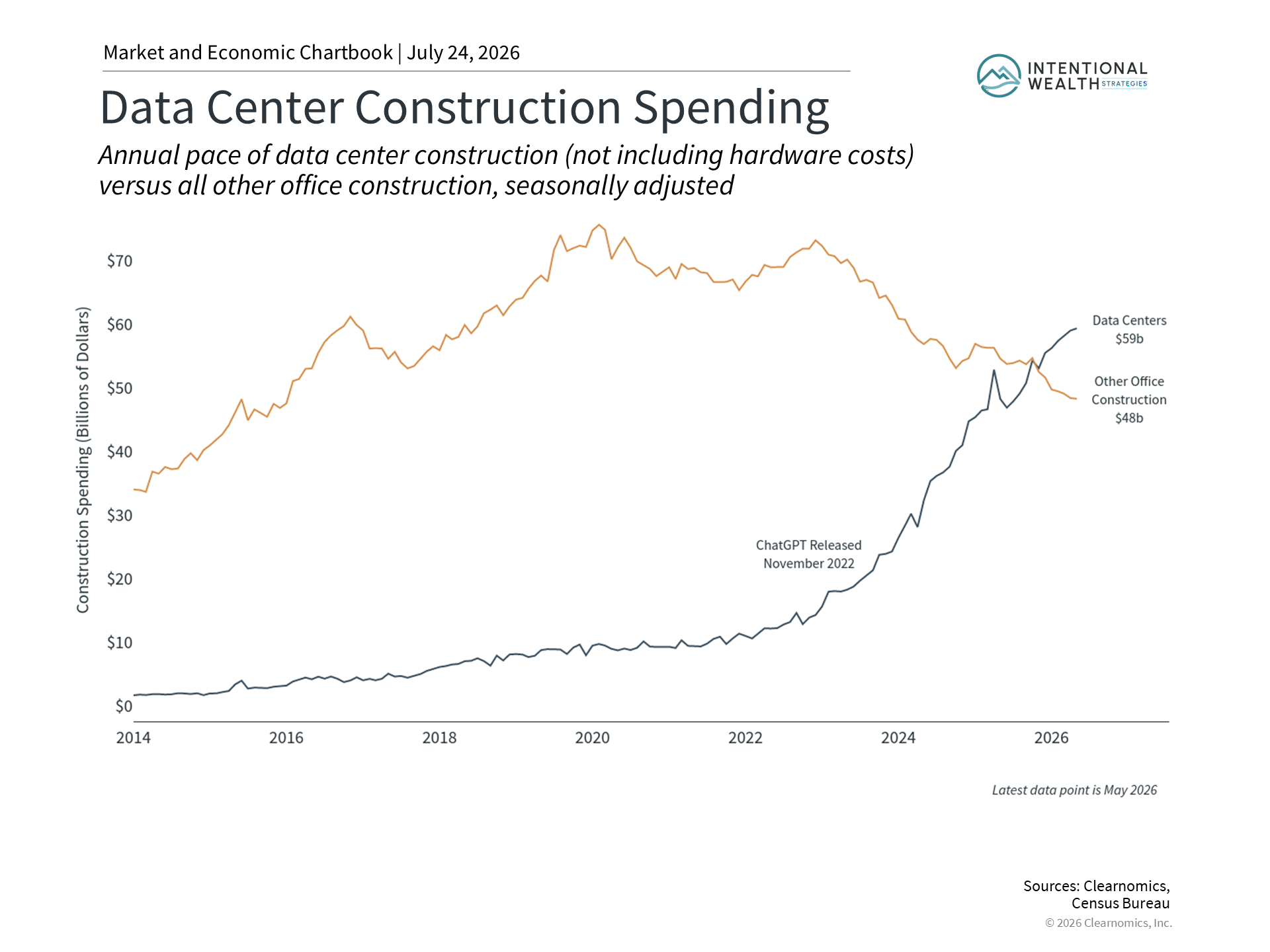
It's natural to think of the model providers — OpenAI, Anthropic, Google, and others — as the heart of AI. But they represent only one piece of the puzzle. There is a full supply chain covering a range of activities, industries, and business models, each with its own characteristics and risks. At the foundation is semiconductor hardware. Chips like GPUs and memory are needed at two stages. The first is model training: building a large language model by processing enormous amounts of data across thousands of connected servers, a process that takes weeks or months to complete. The second is known as "inference" — the everyday use of these models by individuals and businesses. Here's the part worth internalizing: every single time someone asks an AI a question, real computing power is consumed. Chips run, electricity flows, and someone pays for it. Multiply that by billions of prompts a day, and you can see why demand and prices for this hardware have surged — and why demand keeps compounding as more people use these tools. All of that hardware has to live somewhere, which is where data centers come in. Picture a warehouse packed floor to ceiling with servers running 24/7, requiring security, electricity, and constant cooling. Altogether, these represent the enormous resources devoted to making AI applications possible. The chart above shows the amount spent on data center construction, not including the IT hardware. This spending has accelerated dramatically since the launch of ChatGPT in late 2022 — and has now surpassed every other category of office construction combined. It's worth noting that not all of this growth is strictly due to AI. Broader adoption of technology and automation, especially since 2020, has also driven demand for computing power. Finally, there is the application layer: businesses using AI internally and software providers building AI into their products. This is the hardest piece to evaluate right now, because it depends on how effectively companies can turn AI capabilities into productivity gains and product enhancements — one source of market uncertainty over the past year. Will the spending pay off? What the dot-com era teaches us
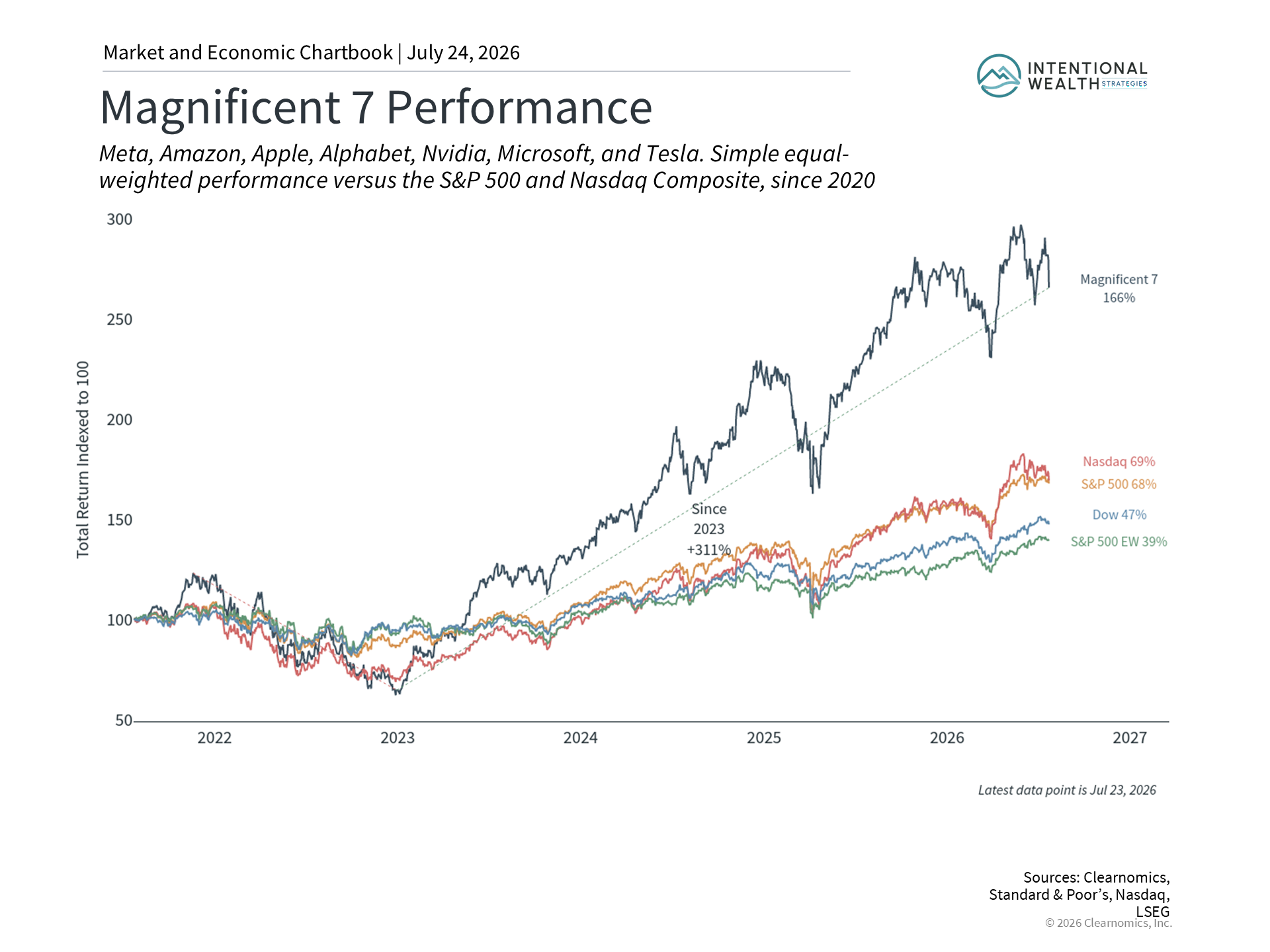
A central question facing investors is whether the hundreds of billions being spent on AI infrastructure will eventually generate sufficient returns. On one hand, demand for computing power to train and run AI models has been substantial. On the other hand, as models improve, they may become more efficient, potentially requiring less computing power for a given task. This uncertainty helps explain the volatility in AI-related stocks. As the accompanying chart shows, mega-cap technology stocks have delivered strong returns over the past several years, but with large swings — periods of optimism about infrastructure spending followed by periods of doubt about demand. That volatility isn't a malfunction; it's the market wrestling in real time with a question nobody can answer yet. Since early 2025, some investors have worried that more efficient AI models will shrink demand for computing power. But history suggests the opposite often happens — a phenomenon economists call the "Jevons paradox." When something gets cheaper, people frequently use more of it, not less. When electricity got cheap, we didn't just light our homes more affordably — we invented refrigerators, air conditioning, and eventually the internet. When computers got cheap, they stopped being tools for large corporations and ended up in every pocket. Cheaper, more capable AI may follow the same path: broader adoption and entirely new uses we haven't imagined yet. At the same time, the dot-com era holds two truths at once. The internet was real — it transformed the economy exactly as the optimists of 1999 predicted. And the bubble was also real: markets dramatically overestimated how quickly that transformation would show up in profits, and investors who paid any price for exposure waited decades for the story to play out. Both things can be true of AI as well. The lesson isn't to avoid AI — it's to hold a broader view of the companies involved and a longer time horizon as the technology and demand evolve. What this means for your portfolio
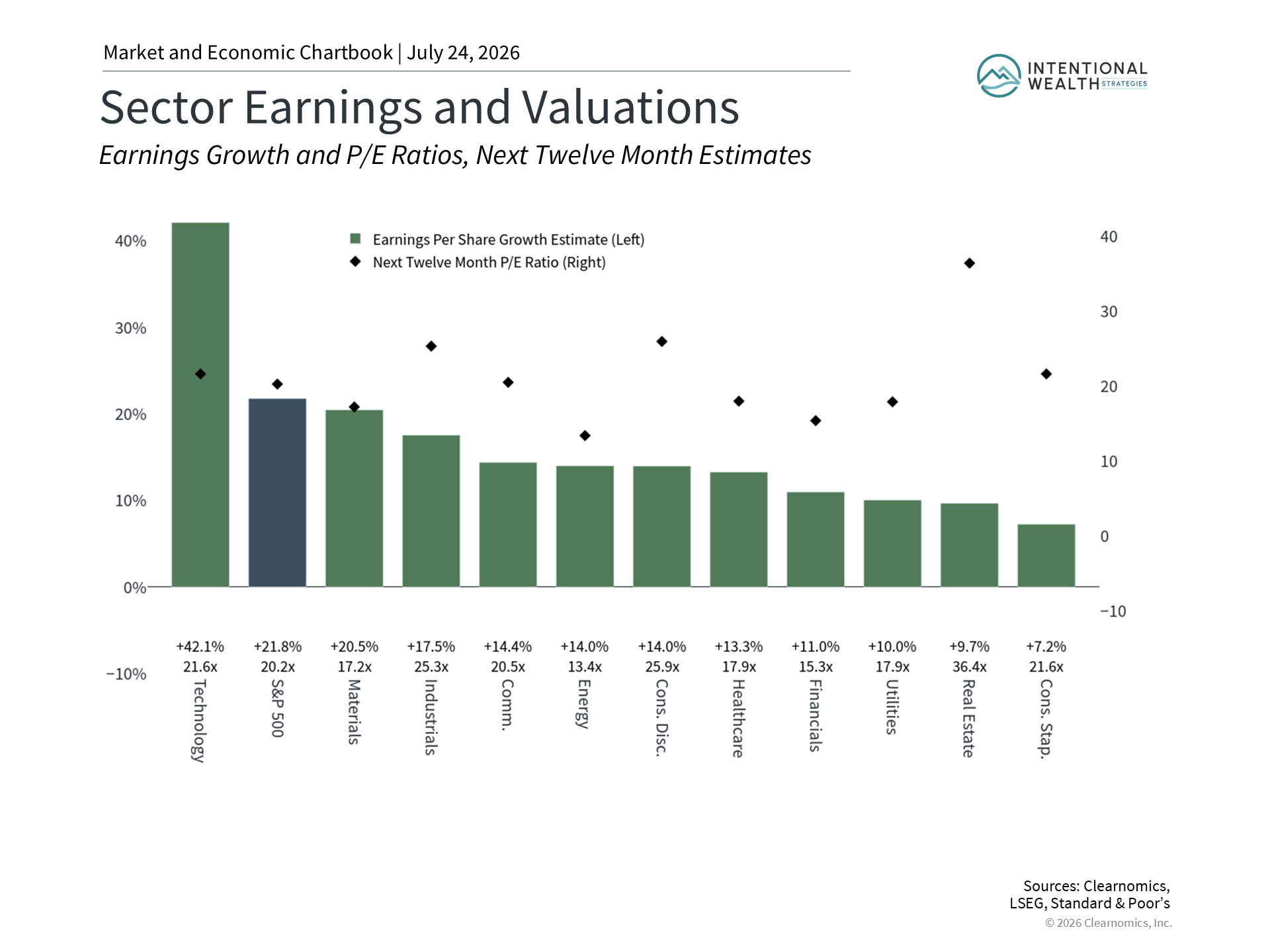
As AI has captured investor attention, valuations for many technology companies have risen steadily. As the chart above shows, Information Technology sector valuations, at 21.4x, are high relative to their own history and the broader market. The same is true for Communication Services and Consumer Discretionary, which also contain large tech companies. At the same time, these valuations partly reflect genuinely strong earnings growth as demand for AI capabilities builds. It's important to remember that valuations are not a tool for predicting what markets will do tomorrow. Instead, they help us decide the appropriate mix of assets in a portfolio, especially when aligning it to financial goals. And right now, many sectors outside the AI spotlight are attractively valued with strong expected earnings growth of their own. This is exactly why a well-built portfolio isn't concentrated in seven stocks — and why that's a feature, not a drag. Diversification means participating in the AI theme where it makes sense while also owning the parts of the market that aren't priced for perfection. The bottom line? The forces driving AI extend far beyond a few famous technology companies. The winners of a technological transformation are rarely obvious in the early innings — which is why a broad perspective, a longer time horizon, and a focus on long-term financial goals remain the most reliable tools an investor has. References 1. https://www.census.gov/construction/c30/c30index.html 2. The Magnificent 7 companies include Meta, Amazon, Apple, Alphabet, Nvidia, Microsoft, and Tesla. Data as of July 17, 2026 3. Clearnomics research and LSEG data as of July 17, 2026 Index Descriptions S&P 500 The Standard & Poor’s 500 Index is a capitalization-weighted index of 500 stocks designed to measure performance of the broad domestic economy through changes in the aggregate market value of 500 stocks representing all major industries. NASDAQ The NASDAQ Composite Index measures all NASDAQ domestic and non-U.S. based common stocks listed on The NASDAQ Stock Market. The market value, the last sale price multiplied by total shares outstanding, is calculated throughout the trading day, and is related to the total value of the Index. | |||

The AI Value Chain: Why AI Investing Isn't Really About the AI Companies